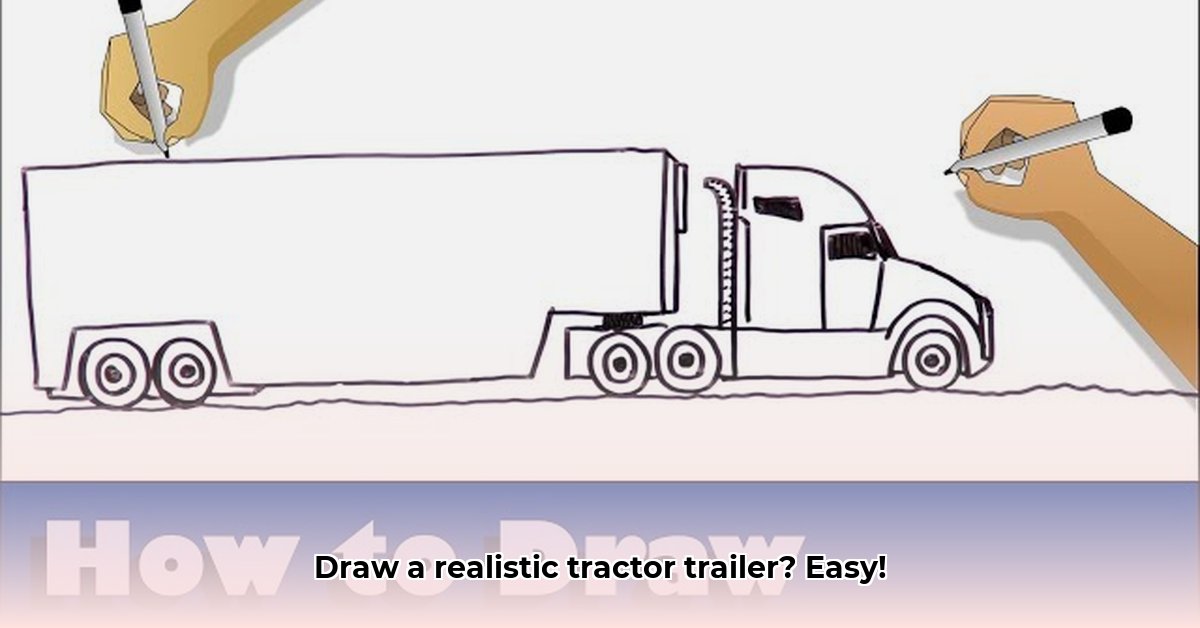
Getting Started: Your Artistic Toolkit
Before we begin, gather your supplies. You'll need:
- A sheet of paper (any kind will do!)
- Pencils: a harder one (HB or 2H) for sketching and a softer one (2B or 4B) for shading.
- An eraser to correct mistakes.
- A ruler (optional, but helpful for straight lines).
For more detailed instructions, check out this easy tractor drawing guide. Did you know that tractor-trailers are essential for sustainable agriculture, transporting crops efficiently and reducing waste? Drawing one is a great way to visualize this important contribution!
Laying the Foundation: Basic Shapes
Even complex machinery like tractor-trailers are built from simple shapes. Let's begin by representing the main components as basic forms.
The tractor cab is essentially a slightly tilted box. The trailer is a long rectangle. And those large wheels? Just circles! Lightly sketch these shapes onto your paper. Don't worry about perfection; this is just a guideline.
Building Your Tractor-Trailer: A Step-by-Step Guide
The Cab: Begin with the tractor's cab. Sketch a slightly trapezoidal shape (wider at the bottom). Add a smaller rectangle on top for the roof. Lightly sketch in the windshield and side windows.
The Chassis: Connect the cab to a long rectangle representing the chassis—the frame connecting the cab and trailer.
The Wheels: Draw four large circles for the wheels—two under the tractor and two under the trailer. Add smaller inner circles for the wheel hubs.
The Trailer: Extend the chassis into a longer rectangle to form the trailer. Keep lines light and loose; slight imperfections are fine at this stage.
Connecting the Parts: Refine your shapes, smoothly connecting the cab, chassis, and trailer. Erase unnecessary guidelines.
Adding Details: Now add the details! Draw headlights, taillights, mirrors, and the exhaust pipe. Give the tires tread by adding lines or bumps. (Refer to real images for inspiration). This step significantly enhances realism.
Bringing It to Life: Shading and Texture
Shading adds depth and realism. Observe how light and shadow fall on different parts of the tractor-trailer. Darken shadowed areas and keep areas in direct light lighter.
Consider the texture of different parts. Tires are not perfectly smooth; add lines or bumps. The smooth metal surfaces of the cab and trailer will reflect light differently than the rubber tires.
Exploring Beyond the Basics: Variations
Want a challenge? Explore different tractor-trailer types! Sketch a fuel tanker, refrigerated truck, or off-road hauler. Each type has unique features that will challenge and improve your skills. Consider adding a background—a field of crops—to illustrate the tractor's role in sustainable agriculture.
Wrapping Up: Your Artistic Journey
Congratulations! You've drawn a tractor-trailer. Drawing is a skill that improves with practice. The more you draw, the better you become! Don't be afraid to experiment and enjoy the process. The journey—and the resulting image—is a testament to your growing artistic abilities and appreciation for sustainable agriculture's technological backbone.